Monday, March 31, 2014

Comparing Federal IT Systems against Commercial Systems: JUST STOP IT!


Every week or so some pundit, politician, or professional writes an article about how the Federal government ought to acquire IT products or services like private industry does.  I believe that idea to be niaeve and irrational. It betrays these folks’ ignorance at best, or political and business motives at worst. There are too many differences between the private versus public purposes, environments and challenges to enumerate, but I’ll discuss some of them below.   

But first, these folks make the false assumption that private industry is more successful at IT projects than are the Feds.  One needs only to read the Standish Group’s annual Chaos Report http://www.csus.edu/indiv/v/veli...
It reports on IT project failure rates and problems in both the private and public sector.  But even this excellent source is dependent on the private sector to volunteer information about their failures.  The press, public and Congress don’t know how many private sector IT projects get strangled quietly in the crib, or buried without a eulogy.  No one knows how many private projects are late, over budget, under functioning or otherwise not meeting the original plan.  So these pundit types need to just stop blindly believing the propaganda and puffery from those who seek to profit from selling IT system development services to Federal agencies. The media pundits need to look for evidence supporting the claims of the ‘private-is-better’ notion.

But let’s explore that ‘private-is-better’ wonderland a bit.  Let’s assume that private industry develops their IT systems better, faster, cheaper than the Feds develop theirs.  What are these systems doing? I hear politicians mention what they apparently believe are comparable systems…. Google; Amazon; Facebook; iTunes; or … which ever.   ‘If Amazon can get your stuff to you in a few days, why can’t Obamacare let you ……blah..blah..’ 

Compared to the functions most Federal IT systems need to perform, these commercial transactions are trivial.  Not that they don’t perform their functions extraordinarily well, but they’re just trivial.  Most of their public-facing transactions are no more than some combination of: 
1.   sign in or sign up 
2.   browse or search
3.   choose from what’s listed
4.   type in a sentence or two (maybe)
5.   give credit card & address (maybe);
6.   Click DONE!  

They don’t really care who or where you REALLY are …… only that the credit card is good and a password/email pair is valid.  

If the ‘private-is-better’ crowd intends to compare private company internal IT systems (finance, HR, accounting, sales or other business functions) these systems are also trivial in comparison to the realities of (Federal) government systems.  Their systems can be built or rebuilt according to the company’s current needs and carry over whatever legacy functions they need to.  In other words, the company can redefine what it needs, jettison what it doesn’t and buy or build what they need. They can follow whatever ‘standards’ they desire (or none).  They can be as careful in handling data and security or as loose as they dare.  They can also roll out these functions at whatever pace is appropriate.  Of course they do, or don’t do these things at their own risk and peril.

In the (Federal) government sphere, agencies and program managers (PMs) have no such ‘freedoms’.  They operate under a totally different set of business rules, mostly driven by Congressionally developed and Presidentially signed legislation and the subsequent translation of the legislation into regulations and procedures… only after the public and commercial entities and lobbiests have provided their input and commentary.  

The agency PMs also operate under procurement rules wherein they can’t just PICK a contractor that the agency likes and trusts. There is a formal public process that governs advertising, specifying the need and giving the marketplace an opportunity to compete to fulfill the requirements.

Even though there are government regulations that constrain some private activities (e.g. various disclosure documents for publicly traded companies). Most private companies building systems do not have congressional actions that impinge on their technical direction and approach, nor do they typically have an unstable set of new/changing executive appointees to contend with.  Nor do they have complex rules and regulations created out of the legislative, rulemaking, legal and public input processes.

In most non-trivial transactions with the Federal government, there are many issues that private sector systems do not address, except in a limited way.  Using Social Security or Medicare or some other claims processing or tax system as a point of illustrating the unique complexities of government systems it becomes obvious that these systems are much more logic and data-centric, pulling from many different sources across organizational boundaries.  A sampling of the issues that the Fed IT world worries about that the private sector typically don’t ---are issues such as:
·      Are you who you say you are? - and how does the agency establish and verify that electronic identity with extremely high accuracy.  Or even when doing a transaction in person, depending on the size and nature of the transaction, great lengths are taken to ensure accuracy of government-known information compared to the in-person representations
·      If you are conducting a transaction for someone else, what is your relationship and legal authority to do so?
·      If you are applying for some kind of disability benefit, you need to provide medical, financial, educational, work history, and other evidence to enable the government to determine your eligibility for a benefit.  And …the government needs to be able to receive, track, validate and associate all of this information with a specific “case”/individual.
·      If you are applying for some kind of educational benefit, you need to supply statements and data about yours and your parents’ financial condition, history and income.

I’m not saying that private sector companies do not have sophisticated, complex systems.  What I’m saying is that those that do, are able to do their business OUT of the public eye (so we don’t know how successful they are), and those that don’t have sophisticated systems… even the ‘trivial’ retail systems have ties to inventory, accounting, buying and delivery systems…. But they are not typically operating across organizational boundaries.  Verizon has still not consolidated their various billing and account systems across ex-NyNEX and all of their acquisitions and business unit consolidations – and they are a ~$24 Billion enterprise  ($21B-wireless $3B-wireline revenue).

So the pundits, pols, prevaracators, just need to examine the reality of Federal IT systems…. And just STOP THE SILLY, ILL-INFORMED, HEADLINE-GRABBING RHETORIC.

Monday, February 24, 2014

Federal IT Contracting 2.0: Solving The Problem With Contractors


The founding principal of federal contracting is competition.  The notion is that through a formal process using both objective and subjective criteria, that the proposal evaluation teams are positioned to pick the best of the competitors.  There is no shortage of detractors of the process.  It’s cumbersome, it’s rigid, it’s bureaucratic, it’s slow, the Federal Acquisition Regulation (FAR) is too big and complex, etc.  Reformers argue that shortcuts of various types need to be taken.  All of that may be true, but I don’t think that those are the things that prevent IT contracts from being much more successful than they currently are.

A typical IT contract awards work to ONE contractor.  I think that this is the basic flaw.  At the time of contract award perhaps the best contractor is the one chosen.  But that contractor doesn’t necessarily STAY the best contractor.  It is no secret that contractors use their “A” business team for writing proposals, and propose their “A” team developers and engineers.  Their actual USE the “A” team on the project is no guarantee except for a few who are officially designated as “key personnel”.  But even that is no guarantee, and there is a process for replacing key personnel.  Even in the rare instance where a contractor delivers the staff exactly as proposed, this ‘best’ team’s performance has a tendency to erode after the ‘honeymoon’ period common to all projects.  This is due to totally normal human behavior.

There is no shortage of material on organizational development, group behavior, management and behavioral sciences, group and individual motivation.  And there is no shortage of methods, consultants, and interventionists to help teams perform to their highest potential. There is not enough of these sources and methods being employed on federal IT contracts.  Of course, for a contractor to employ these tools on a continuing basis, it would add to the costs which would be passed through to the customer via the contractor’s overhead costs.  It’s a thorny problem. 

Here is a solution: All mid to large size IT contracts should award tasks orders of... say... 80% to the ‘best’ contractor and 20% to the ‘next best’ contractor.  Let’s call these the A team and B team contractors.  Simply, the B team is there to keep the A team on their best game.  If the performance of the A team begins to slip, the Program Manager (PM) and the Contracting Officer’s Technical Representative (COTR) and Contracting Officer (KO) have the power and mechanism in place to easily move current or new work tasks from A and award it to B, and vice versa when necessary. Another way would be to have B act as a validation and verification (V&V) team, which allows them visibility into the guts of the project (and ready to take over) This scheme would provide for constant competition among the contractors, and would surely keep their executives and managers engaged in the quality of service on contracts they’ve won – perhaps as much as they worry about the quality of the proposals for the NEXT contract they’ve yet to win.

In the current federal IT contracting environment, competition works well enough…. until there is one winner.  At that point, the game is over.  The Federal IT community needs to figure out how to take advantage of normal human and organizational behavior, along with their survival instincts and revenue goals by incorporating this or other constant competition schemes into their IT contracting playbook. 


EPILOG:  Ironically, amid all of CMS’s failures on the Healtcare.gov system rollout, I think they actually had a similar mechanism in place that saved a chunk of their bacon…or maybe just a few slices. The main contractor’s (A) role was taken over by another contractor (B) who was working on a key part of the system: the ‘data hub’ that routes data between systems and organizations. So contractor B was responsible for getting the system working during the crash effort that was successful at getting – now – millions of folks signed up.  But now CMS has decided to give most of the work to yet another contractor (C).  The next thing to watch on this project is how C behaves, now that they are establishing control and probably recruiting all of the “A” team staff from the original A contractor and B as well.

Friday, February 7, 2014

Federal IT Dashboard: Visibility Into Complex Data or Eye Candy?


The "tree map" below shows the relative size (dollars) of Information Technology (IT) investments in the various Federal agencies. The Defense Department is the largest chunk and the tiny bit in the bottom right corner is the Smithsonian.  This is one of the many displays available to the public on the Federal IT Dashboard.


The idea behind the IT Dashboard is great: Require all major IT investment programs to post and update information about their state and status on a publicly available website.  The information would be available to be scrutinized by interested press, public, auditors, contractors, and those INSIDE the federal government. 

 So, how’s the Federal IT Dashboard working out? 

Two Points.

POINT ONE: the website is a well designed, organized, professional, interactive, and had appealing…. I’d even say ‘gorgeous’ ways of presenting extremely complex, voluminous data.  There are pull down lists for filtering data and for selecting the method of display (tables, graphs, even animated timelines), and there are great visualizations that you can design for yourself that shows the trends in spending, progress and other factors over the last 10+ years.

To understand how (our) ~$76,000,000,000 is being spent on almost 7,400 IT projects, you can and should visit and explore for yourself: https://itdashboard.gov.  You will find information on individual programs and projects as well.  I find that part the most interesting, especially for projects that I was involved in, or read about in the press.  That’s where “POINT TWO” comes in.

POINT TWO: Bureaucracies and the people in them tend NOT to deliver bad news up the chain.  Whether it’s wishful thinking that things will improve, or thinking that nobody is watching, or simply fear of negative consequences is immaterial.  The effect is that rather than having actual insight into a program, those who depend on such data actually have flawed insight.  Well, maybe they have great insight into programs that have no troubles, and little insight into those that NEED intervention from higher up in the chain.  

The data that feeds the IT dashboard is supposed to be reviewed and ‘blessed’ by Chief Information Officers in the reporting agencies, but there also is perhaps a tendency for the CIOs to avoid ‘help’ from up the chain.  If the IT Dashboard had the Healthcare.gov project identified as behind schedule, who cared? If it didn’t identify issues…. What happened?

One way to avoid getting ‘help’ is to modify a program’s basic elements of reporting (cost, schedule, functionality).  All or most reporting systems properly allow changes to these ‘baseline’ factors.  The issue is who keeps up with the rolling and cumulative changes over time?  Too often, a change is the baseline basically becomes a new start for reporting purposes. OR is so confusing in the end, that it becomes almost impossible to figure out what capability the project will deliver….  at what cost.at what date.

In the project shown below, the baseline has been changed 5 times since 2009 (each Δ is a baseline change).  I found this one by searching for a project that was “ALL GREEN”.  But when I looked into the details and the "Evaluation Explanation", I found that they acknowledge having program management problems and their cost profile is RED (on the green, yellow, red scale). In this case I also notice that an adjustment of the baseline was followed by a DECREASE in score rather than what I would expect to be an INCREASE in score (a baseline lets a project reset it's goals, cost estimates, and schedule).


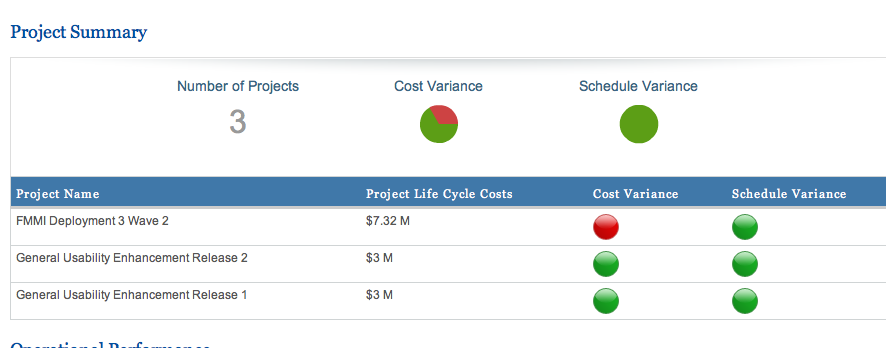
In another graphic, same program, it appears to me that the part of the project that is active is actually RED, but the future parts of the project that are not yet active are GREEN.  I guess the FIVE GREEN cost/schedule scores overwhelm the ONE RED cost score? Even if the RED one is the same cost as the GREEN ones combined?  Jumpin' Jimminy.


From personal experience I can tell you that there are many dedicated people feeding the many data sources that drive the IT Dashboard.  But as that data gets interpreted or adjusted or scored/colorized as it works it's way up the chain leaves lots of room for creeping, serial … . ummm…errrr…ummm.... overly optimistic reinterpretation of the data by the management chain during the data aggregation phase of reporting.

Fortunately there is a lot of semi-raw data on the website for one to explore.  Unfortunately the eye candy charts and graphs don't always reflect the data and may distract and mislead observers who do not dig deeper into the details. This effort is 5 years old, and I guess is still a crawling or walking toddler.  I hope it matures and begins running soon.